The Land Giveth: Forests, Flowers
Heavily stippled with hardwoods, Southern Ohio yields a bounty of forestry-based business. Cabinets, hardwood flooring and bird feeders are among specialties.
It may seem unlikely that a product built for birds could become a half-billion dollar industry, but that's the achievement of Cedar Works in Adams County. The company makes bird feeders and houses from aromatic cedar.
The company was started about 20 years ago by Jim Obenshain who moved to Adams County from Cincinnati. He took the cedar trees out of the woods with a mule and cut them into fencing and mail box posts. He built the business through trade shows and by selling to home centers and hardware stores. About five years ago, he moved his bird feeders into the retail discounters. Today, Wal-Mart is the company's biggest customer, along with such other major retailers as Loews, Home Depot and Target Stores. Most feeders sell for $10 to $25, but for the feeder aficionado there is a $100 "grand gazebo." The company sells throughout the U.S. and exports to Canada, Japan and Europe.
|
Cedar Works starts employees, who are largely unskilled, at $5 an hour, but is generous with periodic raises. There is also an attractive profit-sharing plan and excellent health care coverage. The company employs 240 on two shifts.
"A person might make $7 or $8 an hour by driving to a job in Cincinnati," says Roy Willman, vice president, administration. "But that gets old. It's a lot of time, gas, money and wear and tear on the car. That's one of the things that enables us to be successful -- we have an available work force for $5-$7." |
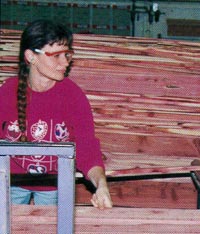
Willman says the bird feeders could be farmed out to a lower cost country, but there are good reasons it isn't. One is the use of aromatic cedar. "You have to be able to cut it efficiently with as little waste as possible, assemble it to make it look good knowing the nuances of cedar, and you have to do those things profitably," he says.
The company's production facility in Peebles cuts the wood into parts, which are assembled at another plant in West Union.
The company works with a Japanese production style -- the "kanban" system, which relies on just-in-time and lean manufacturing concepts.
Competitors have tried to duplicate the product (even copying the packaging) but eventually backed out. Why? "It was very difficult for them to compete with us on a quality and price basis," says Willman. "They couldn't find people who know cedar like we do, train the people and create the feeling of ownership that we create in our team members. With our profit-sharing plan everyone feels a part of the company. We openly discuss problems and issues that come up. By and large, people feel good about working here, and they want the company to succeed. A lot of people knew Cedar Works when we started up on Peach Mountain. It's a homegrown company, and most of the employees are local people."
In adjacent Pike County, the wood products industry is flourishing because of the continuing expansions at Mill's Pride at Waverly. The company employs about 2,500 people.
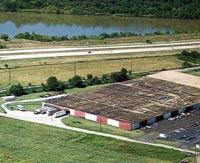
"This site was a soybean field 10 years ago," says Scott Foll, Quality/Customer Service Manager. "It has about 2.5 million sq. ft. under roof now, and the next expansion will add about 459,000 sq. ft."
The company started in Pike County as Dimensional Wood Products. The investor, an Englishman named Malcolm Healey, came in a decade ago with a saw mill and the intention to hire 70 people. Before long there were 200 people, then 300, and the company was building more and more manufacturing space. The expansions continued non-stop for 10 years. Today, an "old" building at Mill's Pride has been up for perhaps two years, and an "old" employee is one who has worked for the company five years.
"I've worked for other companies where this kind of growth would scare them," says Foll. "But this company tends to take it on and go with it. It all starts with the proper vision of where you want to be."
The management concept is unusual. Each plant is set up as a profit center, with its own quality assurance engineer and plant manager. "This way we get a customer/supplier situation on site," says Foll. "One building is a customer of another building but a supplier to another. It also enables the company to manage the profitability better. We get competitiveness among the plants on budgets and quality, and we think that has helped our success."
The lines include ready-to-assemble furniture and kitchen cabinets. Mills Pride reserves its kitchen cabinets for Home Depot only. "This was a way to team up with the cream of the crop in home improvement companies," says Foll. "Our game plan is to have a close relationship with a few dozen customers, as opposed to having 200 whose names we don't know."
Mills Pride ships 200,000 cabinets a week in a highly automated operation. "What helps this company is the product flow," says Foll. "There is very little handling of the product. Automatic conveyor systems allow the product to flow very freely so our machine lines become very flexible. When we get upswings in sales our systems are flexible enough to increase production."
To keep track of the immense square footage, the company named its plants after the 10 most popular U.S. presidents -- Hoover, Grant, Lincoln, Jefferson, Kennedy, Washington, Madison, Roosevelt, Cleveland and Eisenhower. Here, employees dimension and finish wood for doors, laminate particleboard, warehouse, apply vinyl and laminate to doors, sort the lumber and operate the kilns, make parts and components for the doors and package the product. Railcars and trucks stand ready to load the finished product.
Facilities include an on-site cafeteria where all employees receive a free lunch. Employees in distant buildings fax their orders to the cafeteria for delivery.
|
For some counties in Southern Ohio, forest products are the economic life blood. For example, in lightly industrialized Vinton County a dozen sawmills drive the economy.
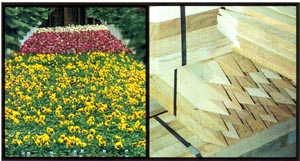
Barber's Surveyor Stakes is a good example of the value-added wood products operations Vinton County supports. The company, in Albany, makes 10,000 hardwood stakes a week, which are sold to surveyors, contractors and utilities. |
|
Also in Vinton County is Fifo Manufacturing, a systems fabricator with a niche in the lumber processing equipment industry.
Over a third of Vinton County's work force leaves for jobs elsewhere each day. There is plenty of qualified labor to staff the additional sawmills, dry kilns and pressure treating plants that could operate successfully in the county. Most of the lumber from Vinton and other Southern Ohio counties is shipped to the southern U.S. for finishing into furniture. Then it is shipped back to the big northern and East Coast markets as furniture, with freight accounting for about half the cost to the consumer.
A region heavy with forests means high production of paper, and Smead Corp., in Hocking County, is one of Southern Ohio's biggest users. Ron Rutter, plant manager, reports the company manufactures and distributes office filing supplies and filing systems, producing a half-billion file folders a year.
The electronic office hasn't hurt Smead a bit. In a business history spanning the manual typewriter to the pentium chip-driven computer, Smead doesn't worry about the paperless office. "When they built computers they built printers," smiles Rutter. Newer products integrate paper and electronic records.
|
Locating in an old shoe factory in Logan in 1946, Smead built a new plant in 1964. After four expansions, factory space now totals 227,000 sq. ft.
From the facility Smead serves surrounding states as well as New England and Canada. Shipping six million pounds of product a month, the company employs 500 in three shifts. Rutter reports a deep pool of available labor. "A year and a half ago we hired 85 people and all but five are from the county," he says. |
The plant has never experienced a layoff. "We'll install automated equipment and eliminate a number of jobs, but right behind that we'll get a new line requiring more jobs," says Rutter. "Smead has an excellent reputation as a good place to work."
It's not just paper that comes into the plant. Smead also buys tons of rolled steel and plastics for the filing systems.
Most machines in the plant are computer-controlled. The company makes some of its own equipment or soups up equipment it buys to drive the company's proprietary manufacturing processes. To keep the work force current on the equipment, the local Ohio University branch holds classes in programmable logic and other technical training in the plant.
While Hocking County has an attractive package of incentives, Smead has never taken advantage of it. "The owner of the company has an old-fashioned business ethic where you don't do something unless you can afford it," says Rutter. "She bought the ground and built the plant without any state assistance."
But, Rutter adds, "if we ever need to expand in the future I'm sure there won't be a problem because this area is very receptive to both start-up and existing businesses. The Community Improvement Corp. makes land and buildings available to support industry. I would encourage anyone looking for relatively inexpensive land and a labor force with a super work ethic to come here."