
A Workable Solution
Ohio's First Frontier of the 18th century is emerging as the state's most exciting frontier of the 21st century. This region of lightly tapped potential has something industry wants: abundant labor.
by Linda Liston
|
A Workable Solution Ohio's First Frontier of the 18th century is emerging as the state's most exciting frontier of the 21st century. This region of lightly tapped potential has something industry wants: abundant labor. by Linda Liston |
In one of the most remarkable economic turn-arounds in U.S. history, Ohio continues to chalk up record levels of corporate investment. For the last four years, the state has attracted more investment in production capacity than any other. *
Yet the sustained growth cycle is not without its side effects. It has sopped up the labor force in some parts of the state. Help wanted ads sometimes go unanswered, and metro area fast food franchisers have taken to enticing workers with wages well above the minimum.
|
For those companies wanting to buy into Ohio's winning business climate, yet are worrying over the available work force, Southern Ohio is worth a look. It has the labor and the transportation linkages to support substantial new economic growth.
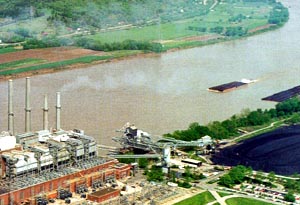
Two transportation features define Southern Ohio. One is the Ohio river, a magnificent artery that outlines Ohio's border for 450 miles. Power plants, chemical plants, steel mills and other industrial neighbors hug its banks. |
The second is State Route 32, the Appalachian Highway. This lightly traveled, limited access four-lane runs the breadth of southern Ohio, from Cincinnati to Athens. Generally straight and level, the highway passes through some of Ohio's prettiest countryside. Spotted among the farms and hills are some huge industrial plants.
Says Jim Obenshain, president of Cedar Works in Adams County: "A four-lane highway runs right through the county, but traffic is virtually nonexistent. State Route 32 ties in directly to the interstate system at Cincinnati. We get trucks out on a timely basis, because they're not tied up with the typical traffic you find in bigger cities."
|
The four-laned highways running off the Appalachian Highway connect southern Ohio with the Columbus and Cincinnati metro areas, as well as with the interstate system. Improvements to several routes -- notably U.S. 33 and 35 -- are well under way. U.S. 23, already a four-lane, is under continuous improvement.
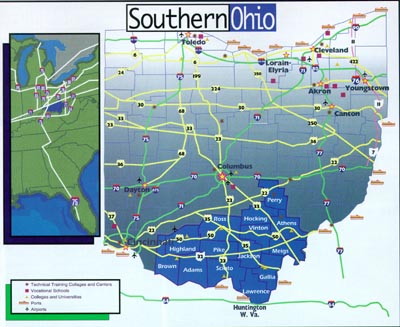
In the offing is even better access. The proposed I-73/74 project will feed Midwest traffic through Southern Ohio. A new interstate highway -- I-73 -- will run from Michigan through Ohio's capital city of Columbus and then south to South Carolina. |
|
It is expected to follow the general route of U.S. 23, which passes through Ross, Pike and Scioto counties. An extension of I-74, which now runs from Chicago to Cincinnati, is expected to feed into the Route 32 corridor. The two new interstates will meet in Southern Ohio.
This is a long-term project -- probably a decade in the decision-making. However, Ohio, anticipating the project, is proceeding with construction of such components as bridges and bypasses.
Ohio is known as the First Frontier, so-named because it was the gateway through which settlers thrust into the Northwest Territory. From this launching point, pioneers traveled the rivers and overland trails to settle the Midwest.
Southern Ohio Defined
For purposes of this report, Southern Ohio covers 14 counties -- from the Cincinnati suburbs on the west to the West Virginia border on the east (see map).
Physically, Southern Ohio is a panorama of undulating fields and Appalachian foothills edged with hardwood forests. Coal and clay deposits underpinned much of the region's early industrialization.
Three features define the region as an economic unit: The river (the Ohio or one of its tributaries), the road (the Appalachian Highway, or one of its feeders), and the work force (in abundance).
Other, less tangible features, also define Southern Ohio. To wit:
The People: Ask the companies in Southern Ohio to describe the character of their employees, and you'll get a smile and a slew of adjectives: "Down to earth, friendly, neighborly, strongly tied to home, family and friends, solid sense of individualism, self reliant, proud."
Says Bob Tinker of Goodyear in Jackson County: "The people are unpretentious, down to earth and have fairly deep religious roots. There is a tremendous amount of activity centered around the church and the school. And they would rather do for themselves than ask the government for anything."
Adds Roy Willman at Cedar Works in Adams County: "Southern Ohio has a lot of family ties and roots. There's a refreshing lack of sophistication, but a refreshing presence of concern and caring. You don't have to worry about security, drugs and violence issues as much as if you were in an urban area"
|
The Work Force: How does that personality play out in the typical worker? Company after company we interviewed for this report stressed the high work ethic of their Southern Ohio employees. Says Craig Thompson of Brown County Economic Development: "Employers are looking for the soft skills -- work ethic, motivation, responsibility. What they don't want to see is an employee who comes in a half-hour late and has no ownership or pride in his work."
"The area has a pioneering work ethic," adds Steve Carter of the Scioto County Economic Development. "The people are very loyal. Generation after generation stay in the area because of connections to the beautiful land, family, good jobs and opportunities in business and education." |
|
Further, these people are willing to travel long distances for jobs. This is most pronounced in the counties that are within an hour's drive of Cincinnati or Columbus. "We've got 3,000 cars leaving the county every day for jobs in Columbus," says Hugh Morton of the Hocking County Community Improvement Corp. "We want them back."
|
The Companies: Like the generations of families that stick to Southern Ohio, companies settle in and stay. There are numerous examples of Fortune 500 companies that have been in Southern Ohio for decades. Says Ron Rutter, plant manager at Smead Corp., which has been in Hocking County for over 50 years: "People know that when an industry comes to town it's going to stay."
The Lifestyle: Don't expect big city glitter in Southern Ohio. Sure, there's plenty to do, but it's likely that events are going to be centered around family, school, church. Of course, Cincinnati, Columbus and Huntington, W. Va., are within reasonable driving distance of most of Southern Ohio when you need a dose of city fare, a big league ball game or a concert. Bob Tinker, plant manager at Goodyear in Jackson County, calls the Southern Ohio lifestyle "pleasantly paced." " It's easy to live in and get around in," he says. "It doesn't have everything a metro area has, but it's got a nice neighborliness about it. It feels good." Of course, Southern Ohio's small cities like Portsmouth, Chillicothe, Athens and Gallipolis offer excellent cultural, medical and shopping amenities. Portsmouth, for example, has a wonderful Performing Arts Center, touted as one of the best east of the Mississippi River. Athens bills itself as "rural cosmopolitan," offering all the amenities of a typical college town. Chillicothe has its outdoor drama and Paints baseball team, a Class A team in the Frontier League. Gallipolis has one of the state's renowned medical clinics, the Holzer. The Landscape: In a word, beautiful. The eyes rest on rolling hills stippled with hardwoods, river views, hidden valleys and vintage towns. This is the kind of environment more and more Americans are returning to. "Country's in," says Steve Triplette, editor at of the News Democrat in Georgetown(Brown County). "A lot of the city folk are coming here because they want to get away from the urban areas. They want their five acres and a one-hour drive to work. People are after their slice of heaven, and it's here." |
|
With that introduction to Southern Ohio, we follow with stories of outstanding successes in several industry sectors. In each instance, labor quality and availability was a key component of the success.
* Site Selection's tally ranks Ohio in first place in total
number of new plants and expansions for 1993-1996.